Casa Aurora · Ravenna, ItalyAngelo Mariani, the conductor born in Ravenna, Italy
Angelo Mariani, born in Ravenna on 11 October 1821, became one of the best-known conductors of his century: Verdi's friend and interpreter, and the first to conduct Wagner in Italy. A plaque on the front of Casa Aurora records his birth.
From Ravenna to his first posts
He came from a modest family. At eleven he began studying theory and violin at Ravenna's Accademia Filarmonica, and Count Roberti, the cathedral organist, taught him harmony free of charge.
His first permanent post came in 1842, leading the town band in Sant'Agata Feltria, now in the province of Rimini. Thirty years later the town named its newly restored theatre after him. In 1844 Rossini wrote to praise a symphony of his performed in Faenza; Mariani moved to Bologna and studied with him for a while.
Years of travel followed. In Austrian-ruled Milan in 1846 he conducted a Nabucco so impassioned that it nearly caused a riot, and the police reprimanded him. He then worked at the court theatre in Copenhagen and in Constantinople.
Two roles in one
In 1852 Genoa gave him its new civic orchestra at the Carlo Felice theatre, a permanent ensemble funded by the city, the only one of its kind in Italy. He led it until his death, and from 1860 also ran the orchestra of the Teatro Comunale in Bologna.
In Italian theatres at the time, the maestro concertatore prepared the performance and the direttore d'orchestra led the players: two tasks, often in different hands. Mariani was among those who merged them into one figure, the modern conductor, though as late as 1857 he still conducted with a violin bow, not a baton. He chose singers and repertoire and introduced auditions for orchestral players. In an 1862 letter he wrote that “a true conductor must also direct and regulate everything”.
Verdi and Wagner
He probably met Verdi in Milan in 1846. Mariani conducted the premiere of Aroldo in Rimini in 1857 and the Italian premiere of Don Carlos in Bologna in 1867; in Genoa, where Verdi and Giuseppina Strepponi spent several winters, he saw a lot of them.
The friendship ended between 1870 and 1871. A romantic entanglement involving the soprano Teresa Stolz played a part, as did Mariani's refusal to conduct the Aida premiere in Cairo and a dispute over the freedom a performer may take, which Verdi rejected. Even so, in 1871 Verdi still thought him the finest conductor in Italy.
On 1 November 1871, at the Teatro Comunale in Bologna, Mariani conducted Lohengrin, the first Wagner opera staged in Italy; Tannhäuser followed on 11 November 1872. He also corresponded with Wagner. Ill since 1868, he died in Genoa on 13 June 1873.
The plaque and the Angelo Mariani room
On the front of Casa Aurora, in Via Giuseppe Pasolini, a plaque marks this spot as the place where Mariani was born in 1821.
On the ground floor is the room named after him, with a sitting room, a bedroom, two bathrooms and a small private garden. The building also has original 18th-century exposed beams in the Teodorico room.
Mariani in Ravenna today
The plaque can be read from the street. The Teatro Alighieri, the city's main theatre, is on Via Angelo Mariani: it opened on 15 May 1852, the same day Mariani took the podium at the Carlo Felice in Genoa. The Biblioteca Classense holds a copy of the autobiography he wrote in 1866, along with letters to and from him.
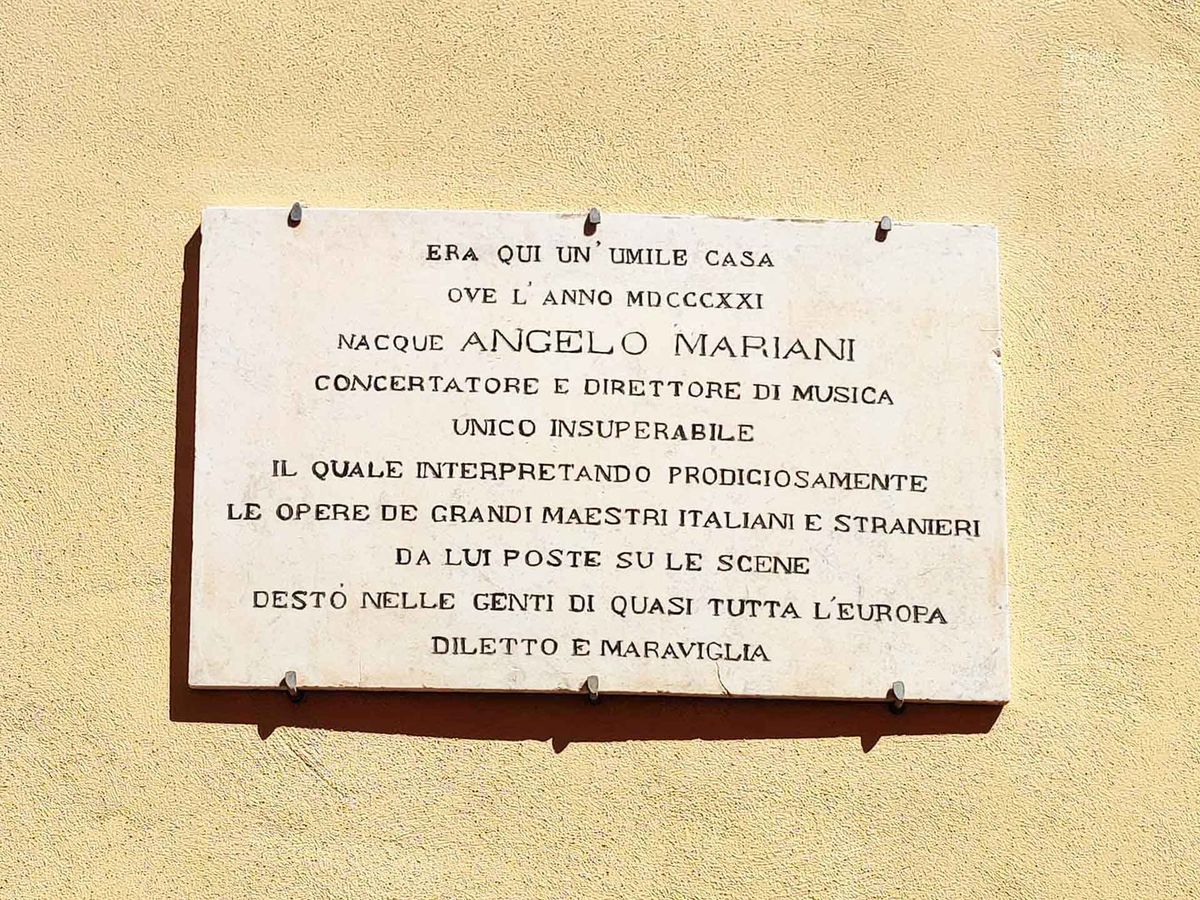
Era qui un'umile casa
ove l'anno MDCCCXXI
nacque Angelo Mariani
concertatore e direttore di musica
unico insuperabile
il quale interpretando prodigiosamente
le opere de grandi maestri italiani e stranieri
da lui poste su le scene
destò nelle genti di quasi tutta l'Europa
diletto e maraviglia“Here stood a humble house where in the year 1821 Angelo Mariani was born, concertatore and director of music, unique and unsurpassed, who, interpreting prodigiously the works of the great Italian and foreign masters that he brought to the stage, stirred delight and wonder in the peoples of almost all of Europe.”